
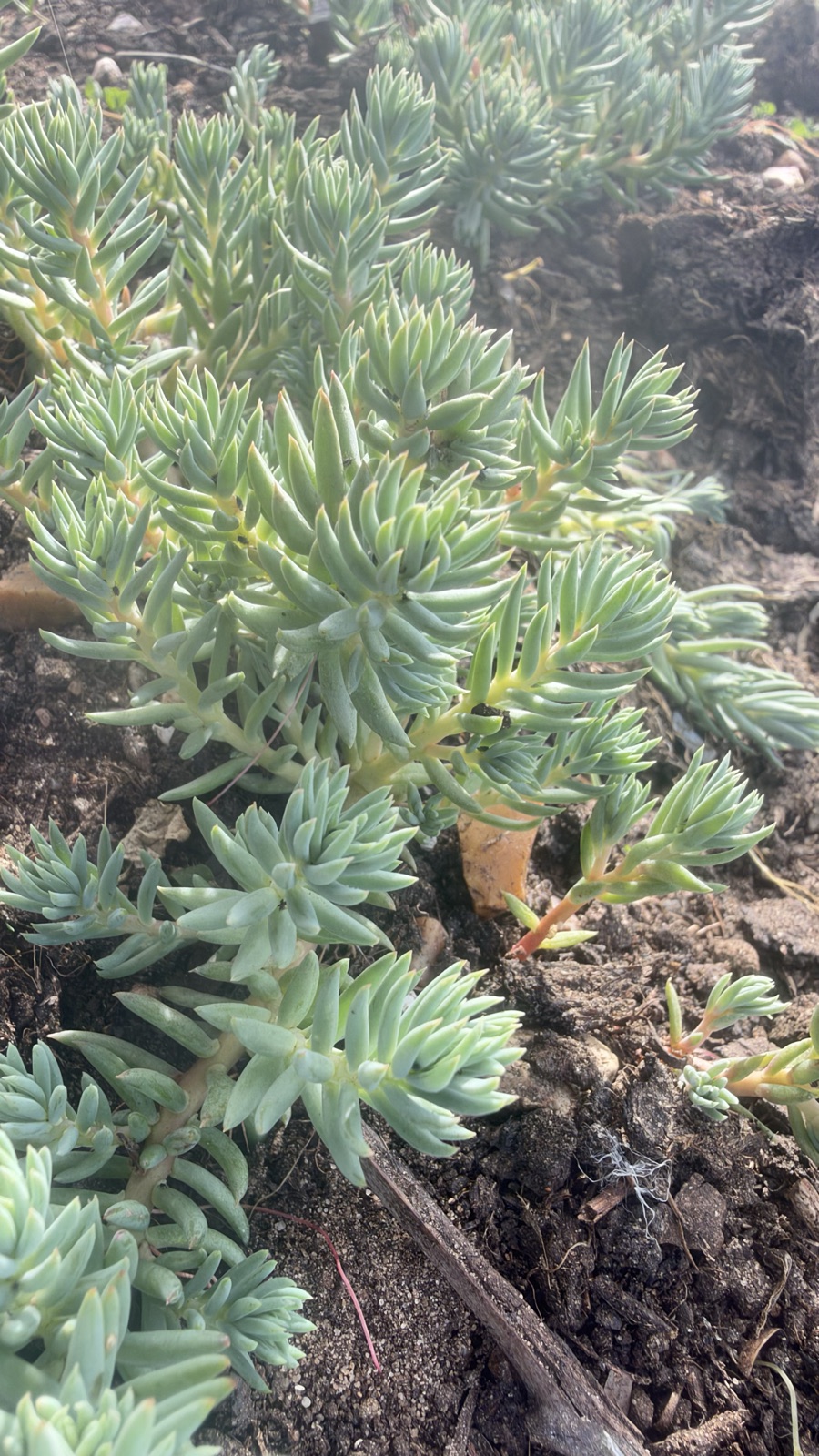
Run your hand over Sedum rupestre 'Blue Spruce' and it feels like a dwarf conifer. Each upright stem is clothed in short, pointed, blue-grey leaves arranged like the tip of a spruce branch, and a well-grown patch looks like a miniature forest seen from above.
This guide focuses on what makes Blue Spruce different from its golden and silver relatives, why it is such a reliable choice for sedum roofs, how to plant and water it, and how to care for the small blue gift pot version. You will also find propagation tips and the handful of problems it can meet.
Sedum rupestre 'Blue Spruce' at a glance
- Botanical name Petrosedum rupestre 'Blue Spruce', still widely sold as Sedum rupestre or Sedum reflexum 'Blue Spruce'
- Common name Blue Spruce stonecrop, reflexed stonecrop, stone orpine
- Plant type Evergreen, mat-forming succulent perennial
- Hardiness RHS H5 (down to about -15 to -10°C)
- Height and spread Around 10cm in leaf and up to about 20cm in flower, spreading 30 to 45cm
- Flowering Clusters of starry yellow flowers on upright stems in summer
- Foliage Short, needle-like blue-grey leaves packed along the stems like conifer shoots, evergreen
- Position Full sun
- Soil Poor, gritty, well-drained soil, neutral to alkaline
- Good for Green roofs, rockeries, gravel, troughs and small gift pots
Why the spruce form stands out
Reflexed stonecrop comes in several colour forms. Blue Spruce is the coolest of them, with leaves of steel blue that turn slightly greyer in drought and take on purplish tips in a cold spell. Golden selections sit at the warm end of the scale and silver forms are paler and more powdery, so Blue Spruce is the one to choose when you want a solid, cool-toned block of texture.
Its stems are also among the most upright and bristly, which gives that conifer outline even when the plant is only a few centimetres tall.
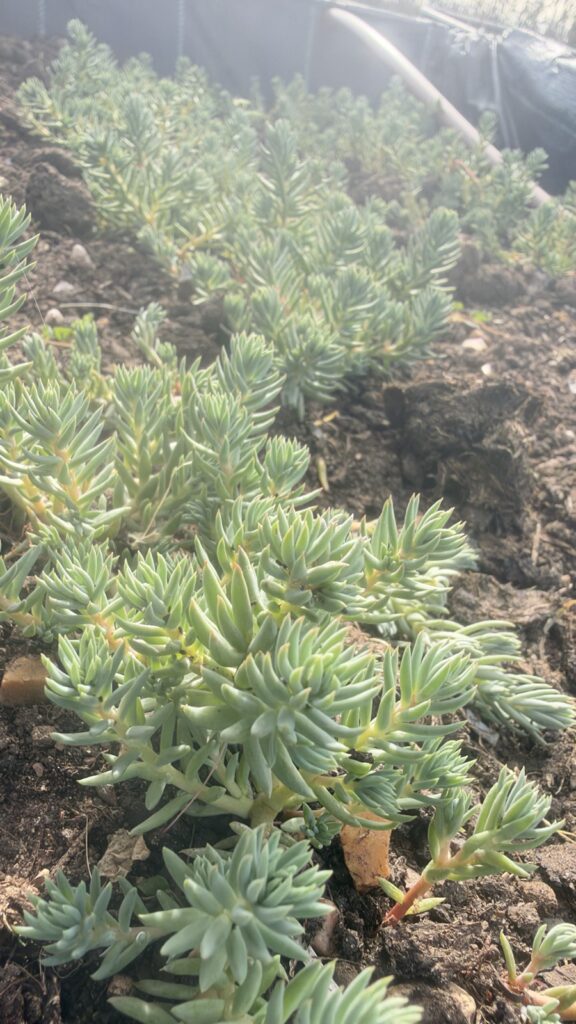
A workhorse for green roofs
Blue Spruce is a favourite on shed, bike store and log store roofs because its shallow roots manage in 5 to 8cm of growing medium, it holds water in its fleshy leaves and it stays green through winter. Its taller habit adds height among the low mats of Sedum album and Dragon's Blood.
Plant plugs about 15cm apart in a light, gritty substrate in spring, water them in, and expect full cover within one or two growing seasons. Our step-by-step guide to putting a green roof on a shed or store covers the layers and weight in more detail.
Planting on the ground
At ground level it does best in a rockery, gravel garden or raised bed in full sun. It prefers lean, stony soil, so on clay dig in generous amounts of grit and set plants on a slight ridge.
Space plants about 30cm apart and keep them away from lush, leafy neighbours that would shade them. The blue tones look sharp against dark slate chippings, terracotta or the purple leaves of heuchera and Dragon's Blood.
Watering without overdoing it
Established plants in open ground almost never need watering. On a roof, water during the first summer and again only in a prolonged drought, when the leaves begin to look shrivelled and dull.
In pots, soak the compost and let it dry out before the next drink. Persistent wet compost in winter is the quickest way to lose it, so tilt or raise containers to shed rain.
Caring for the 6cm blue gift pot
We also sell Blue Spruce in a small 6cm blue pot, which makes a neat, long-lived present. It can sit on a bright windowsill for a while, but it is a hardy outdoor plant at heart and keeps its shape far better outside.
Water sparingly, roughly once every two or three weeks indoors, and do not leave it standing in water. Within a few months, pot it on into a trough or plant it in a sunny rockery where it can spread.
- Give it the sunniest windowsill you have while it is indoors.
- Move it outdoors from spring, hardening it off over a week or so.
- Plant it out in gritty soil or a larger pot with drainage holes.
- Keep it outside over winter, as cold does it no harm.
Flowers, trimming and winter
In summer, taller stems rise above the foliage carrying flat heads of yellow stars. Some gardeners love them and others snip the stems off to keep the blue carpet uninterrupted. Either way, cut off spent flower stems once they fade.
The RHS rates the species H5, hardy through most of the UK in all but the harshest winters. It keeps its leaves all year and needs no protection in the ground, though a gravel mulch around the stems helps on damp soil.
Making new plants
Blue Spruce roots from almost any stem piece. Pinch off 5 to 8cm tips from spring to late summer, strip the lowest leaves and push them into gritty compost or straight into a roof substrate. They usually root within a few weeks.
Larger clumps can be divided in spring. Ease up a section, tease it apart into rooted pieces and replant at once.
Troubles to watch for
Stems that blacken and collapse at the base point to rot from poor drainage. Remove them, take cuttings from healthy shoots and add more grit. Birds sometimes pull at new plugs on roofs, and vine weevil grubs can damage plants in pots.
Reflexed stonecrop was once eaten in salads, and it is generally considered low risk to pets and children, but discourage nibbling all the same.
Questions about Sedum rupestre 'Blue Spruce'
What is the difference between Sedum Blue Spruce and Angelina?
Both are forms of reflexed stonecrop. Blue Spruce has blue-grey leaves and an upright, bristly habit, while Angelina has golden-yellow foliage that turns orange in cold weather. They look very good planted together.
Is Sedum Blue Spruce good for a green roof?
Yes. It copes with shallow substrate, drought and exposure, and it stays evergreen. Its taller stems add texture among lower roof sedums.
Does Sedum Blue Spruce spread?
It spreads steadily by creeping stems to form a mat about 30 to 45cm across. It is easy to keep in check by pulling up stray pieces.
Why has my Blue Spruce sedum gone leggy?
Leggy, stretched stems are almost always caused by too little light, often from being kept indoors. Move it into full sun outside and trim the long stems, using the tips as cuttings.
Blue Spruce is grown on our Lincolnshire farm alongside dozens of other stonecrops, so it is easy to mix colours for a roof or rockery. Have a look through the full sedum collection to find partners for it.