
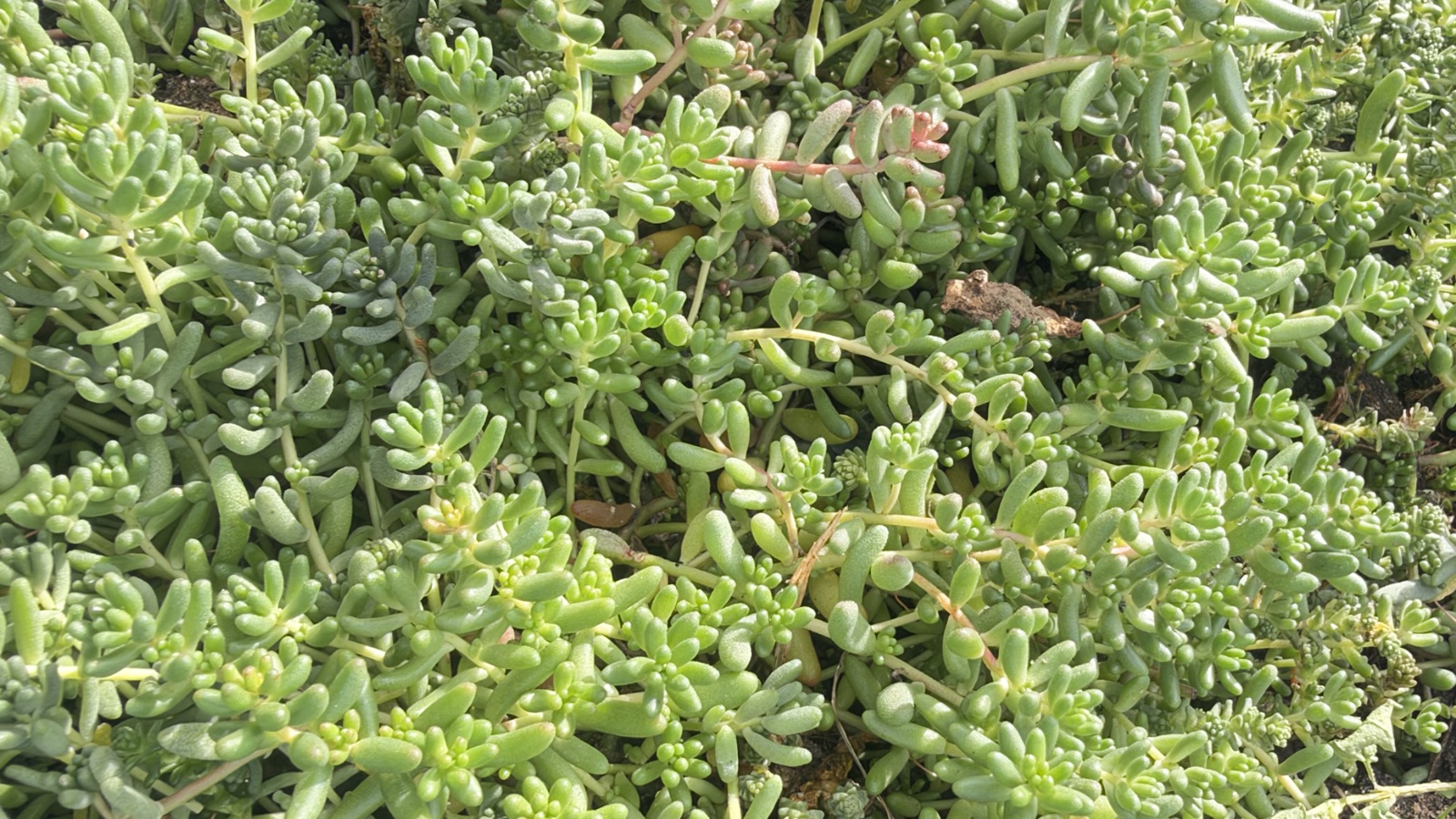
White stonecrop is the plant that turns a bare shed roof or a crumbling wall into a living green blanket. Sedum album 'Athoum' is a vigorous, bright green form that roots almost anywhere a leaf falls, then smothers itself in frothy white flowers that bees adore.
Botanists now treat the name 'Athoum' as part of the wider species Sedum album, so it may turn up under several labels. Whatever the tag says, the care is the same. This guide explains where it does best, how to plant it, how to keep it in bounds and how to use it on roofs and walls.
Sedum album 'Athoum' at a glance
- Botanical name Sedum album 'Athoum' (sometimes listed as Sedum album var. athoum or Sedum athoum)
- Common name White stonecrop
- Plant type Evergreen, creeping succulent perennial
- Hardiness RHS H7 (hardy below -20C)
- Height and spread 5 to 10cm in leaf, flower stems to about 15cm, spreading 30 to 50cm
- Flowering Clusters of white, sometimes pink-flushed, starry flowers from June to August
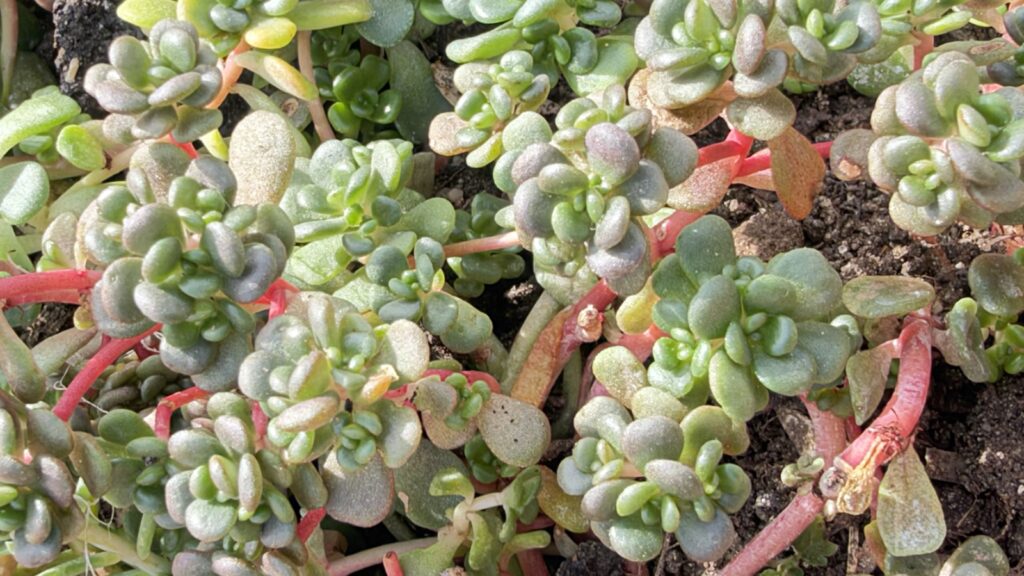
- Foliage Small rounded bright green leaves that turn red and bronze in cold or drought
- Position Full sun, tolerates very light shade
- Soil Any well-drained soil including thin, stony and chalky ground
- Good for Green roofs, wall crevices, paving gaps, pollinator gardens and gravel
Why white stonecrop is a green roof favourite
Sedum album is one of the backbone species on commercial sedum roofs across Europe. Its roots need only a few centimetres of growing medium, it survives weeks without rain and its fleshy leaves store enough water to stay green through most British summers.
In drought the leaves blush red and bronze, which is a survival trick rather than a sign of distress. The colour fades back to green once rain returns. If you are planning your own roof, our guide to putting a green roof on a shed or log store walks you through it.
Where should you plant it
Full sun gives the densest mat and the most flowers. It will cope with a little shade for part of the day, though growth is looser and flowering lighter.
Because it spreads quickly, think carefully before planting it next to small, slow alpines that could be swamped. It is happiest in places other plants find too harsh, such as cracks in paving, the top of a retaining wall, gravel drives or thin soil over rubble.
Planting white stonecrop
Spring and early autumn are ideal, though pot-grown plants can go in at any time the ground is not frozen or baked hard. It tolerates poor, chalky and sandy soils and actually colours better without rich compost.
- Loosen the top few centimetres of soil and mix in grit if it is heavy.
- Plant at the same depth as the pot, about 20 to 30cm apart.
- For walls and paving gaps, push small rooted pieces into a pinch of gritty compost.
- Water once to settle the roots, then leave it to establish.
Water and food, kept to a minimum
In the ground, water only during the first few weeks after planting. After that, an established mat of 'Athoum' will survive a dry Lincolnshire summer on rainfall alone.
Container plants need watering when the compost has dried right through, perhaps weekly in high summer. Feeding is unnecessary and tends to produce soft, sprawling growth. On a green roof, a light slow-release feed in spring every couple of years keeps the cover thick.
Over winter it needs no protection at all. With an H7 rating it takes the hardest British frosts in its stride, and its only demand is that rain drains away rather than pooling around the stems.
Keeping it in bounds
Every leaf that breaks off can root, which is wonderful on a roof but can be a nuisance in a fine rockery. A quick tidy each spring keeps it where you want it.
Pull up stray pieces by hand, as the roots are shallow and lift easily. After flowering, shear the faded stems off so the mat looks neat and seedlings are kept to a minimum.
Propagation could not be easier
Scatter a handful of broken shoots over gritty compost or bare soil, press them in lightly and keep them just moist. Within a few weeks they will have rooted and begun to spread.
This is how sedum roofs are often established, with cuttings spread over the growing layer in spring. For a quicker effect on a small roof or bed, plant whole plugs and fill gaps with cuttings.
A magnet for bees and butterflies
Sedum album carries the RHS Plants for Pollinators mark, and when the white flowers open in summer the mat hums with honeybees, solitary bees and hoverflies. Small butterflies visit too.
Leave a patch unclipped near a seating area so you can watch the activity. Pair it with thymes, Origanum and Sedum acre for a long succession of nectar in a hot, dry spot.
Pests, problems and pets
Outdoors it is remarkably trouble free. The main issues are rot on badly drained ground in winter and occasional vine weevil grubs in pots. Fix drainage with grit and use nematodes against weevils in late summer.
Birds sometimes pull at newly planted roofs, so pegging fine netting over cuttings for a few weeks helps. White stonecrop is not known to be toxic to cats or dogs, though eating large amounts may cause mild stomach upset.
Questions about Sedum album 'Athoum'
Is Sedum album invasive?
It spreads freely by rooting fragments and can self-seed, so it can swamp very small plants. It is easy to pull out by hand and is not classed as invasive in the UK. Treat it as a vigorous groundcover and give it space.
Why has my white stonecrop turned red?
Red or bronze leaves are a natural response to drought, strong sun or cold. The plant produces pigments that protect it under stress. It will return to green with rain or milder weather and does not need treatment.
How thick does soil need to be for Sedum album on a roof?
Around 5 to 8cm of free-draining growing medium is enough for white stonecrop. Thinner layers work in mild areas but dry out quickly. Always check your roof can carry the weight of saturated substrate before you start.
When does Sedum album Athoum flower?
White stonecrop flowers from June to August, with the main show in high summer. The buds are often flushed pink before opening to clusters of white stars on stems a few centimetres above the leaves. For several weeks the green mat can almost disappear under the blooms.
White stonecrop is one of the easiest ways to bring life to hard surfaces and dry corners. Sedum album 'Athoum' sits with plenty of other roof-friendly stonecrops in our Sedum collection, grown on our Lincolnshire farm and ready to plant.